





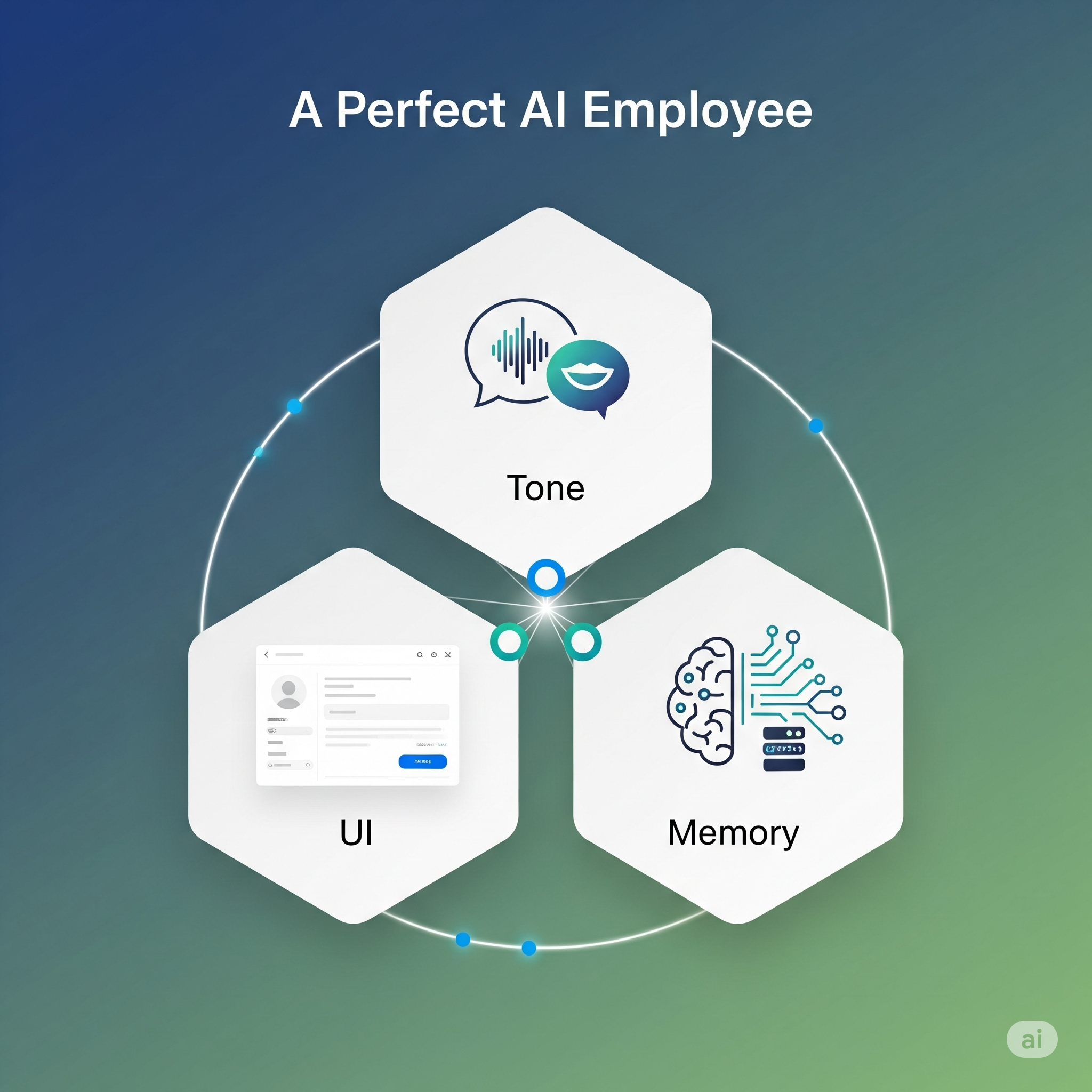
A successful AI employee is not simply an “AI that gives the right answers.” To truly work effectively in a business environment, AI must be designed with 3 core elements: interface, tone of voice, and memory. These factors help AI become a “trusted colleague” – not only accurate but also friendly and easy to use.
1. Interface – The first bridge between users and AI
Role:
- The interface shapes the user’s first impression when interacting with AI
- Easy-to-use, intuitive design increases adoption rates and implementation effectiveness
Good design requires:
- Clearly showing the AI’s role (e.g., “I am OneXBots AI Customer Service Assistant”)
- Using recognizable icons/avatars and tailoring the interface to each channel (website, internal system, social media…)
- Providing response states (typing, processing, sending files…)
2. Tone of voice – The soul of enterprise AI
Why it matters:
- Tone of voice reflects brand culture
- Directly influences customer perception: friendly – professional – serious – approachable, etc..
Tips for building tone:
- Define tone of voice according to industry (education vs. finance, F&B vs. healthcare)
- Use language that has personality but is not rigid
- Customize by role: AI customer service speaks differently from AI accounting or AI marketing
Examples:
- “Hello! How can I support you today?” (friendly)
- “Please provide your order code so I can check it for you.” (professional)
3. Memory – The capability that makes AI a ‘real employee’
Benefits of AI memory:
- Remembers conversation context (what the customer said earlier)
- Retains company processes, policies, and product information
- Personalizes the experience (greets by name, recalls orders, understands customer habits)
OneXBots supports memory types:
- Short-term memory: remembers during a session
- Long-term memory: remembers across multiple conversations (if data integration is enabled)
Notes for setting up memory:
- Regular updates are needed to avoid outdated information
- Build with clear rules to prevent AI from “misinterpreting”
Combining all 3 elements to create the ideal AI employee
An effective AI employee requires alignment between:
- An accessible interface
- A tone of voice that fits company culture and each department
- Accurate memory that enables deep personalization
Summary:
When designing an AI employee, think of it as a true team member. Interface – tone of voice – memory are the foundations that enable AI to communicate effectively, align with company culture, and create a memorable user experience.
Are you ready to design an AI employee that carries your company’s unique identity? Let OneXBots accompany you from the very first step.